
CNC machine shops face a staffing problem that isn’t getting easier. The operator whose entire job is standing at a machine, loading and unloading parts every few minutes, is increasingly hard to hire, harder to retain, and not where skilled machinists want to spend their time.
Machine tending — the load/unload work around a production CNC machine — consumes an estimated 30 to 50 percent of operator time in precision machining environments. Meanwhile, most CNC machines operate at only 60 to 75 percent of their potential capacity. The rest is lost to idle time between cycles while an operator is away from the machine.
Robotic CNC machine tending closes both gaps at once. This guide covers what CNC machine tending is, how a tending cell works, which machines and jobs are the best candidates, how to evaluate whether it makes sense for your shop, and what solutions Absolute Machine Tools offers for manufacturers ready to get started.
What Is CNC Machine Tending?
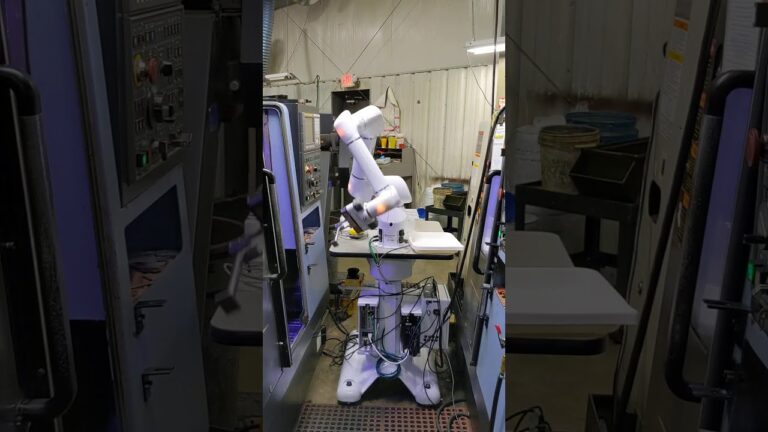
CNC machine tending is the use of a robot or cobot to load raw parts into a CNC machine, initiate the machining cycle, and unload finished parts when the cycle completes. The process repeats continuously as long as parts are available.
It is also called robotic machine tending and cobot machine tending. The distinction between robot and cobot matters for how the cell is designed, but the core application is the same: a machine runs without a human standing at it.
Machine tending is the most common first automation application for CNC shops. It is well-suited to the work because the task is clearly defined, the motions repeat identically every cycle, and the machine itself already does the precision work. The robot handles the parts.
How a CNC Machine Tending Cell Works
A standard machine tending cycle follows these steps, repeated automatically for every part in the run:

- The cobot picks a raw part from the staging area or fixturing tray.
- The cobot moves to the machine and waits for the M-code signal indicating the machine is idle and the door is open.
- The cobot loads the raw part into the chuck, fixture, or vise.
- The cobot sends a completion signal to the CNC control.
- The CNC machine begins its machining cycle and the cobot moves clear.
- When the cycle finishes, the CNC sends an M-code signal to the cobot.
- The cobot opens the machine door (or an auto door kit opens it automatically), removes the finished part, and deposits it to the finished-parts staging area.
- The cobot picks the next raw part and the cycle repeats.
The communication between the cobot and the CNC machine in steps 2, 4, and 6 is what distinguishes a true integration from simply placing a cobot near a machine.
According to Dave Zunis, Absolute’s Director of Service and Applications Engineering: “Most integrators will say they can integrate a cobot to any CNC machine tool. However, this is often not the case. The technician integrating the cobot to the CNC needs to be able to read and understand the ladder logic within the CNC control. If they don’t, they will use your time and money to learn it.”
The depth of integration required depends on the application. A cobot that presses an external start button rather than wiring into the machine’s I/O is simpler to set up but less flexible. A full M-code integration — where the cobot and machine exchange signals for every step of the cycle — is more capable and more reliable for lights-out operation.
When Machine Tending Makes Sense (and When It Doesn’t)
The single best predictor of whether machine tending will deliver strong ROI is idle spindle time. If a machine sits idle between cycles because an operator is away, machine tending automation pays. If the machine is already running continuously and the bottleneck is elsewhere in the process, the return will be lower.
|
Choose Machine Tending When |
Reconsider When |
|---|---|
|
One operator is locked to one machine for the full shift |
The job requires dexterous in-process work (deburring, gauging) a gripper cannot perform |
|
The machine sits idle during breaks, shift changes, or overnight |
Machines are too far apart for a cobot to serve more than one |
|
The job runs the same part geometry for long runs or repeating batches |
Part geometry changes so frequently that changeover time eliminates the gain |
|
Cycle times are consistent and the process is proven attended |
The process has significant variation in cycle time, tool wear, or part quality |
|
The shop has a labor shortage affecting the tending position |
A skilled operator is needed at the machine to make process decisions during the run |
What Parts and Jobs Work Best
Not every job is ready for machine tending on day one. The best candidates share these characteristics:
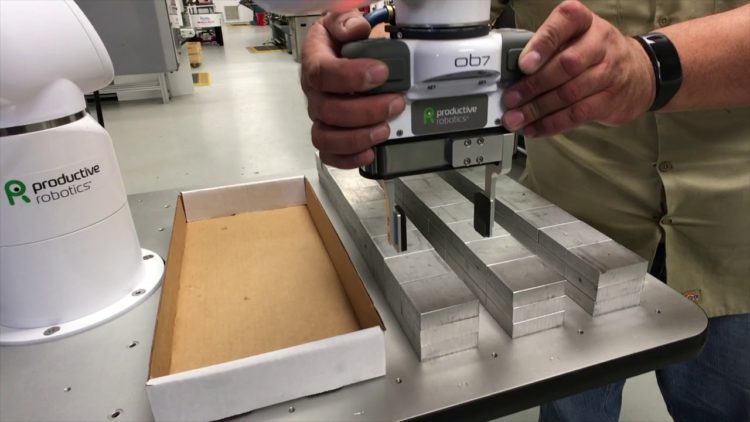
- Consistent part geometry. The cobot picks from the same location and orientation every cycle. Parts with predictable, repeatable geometry are easier to fixture and pick reliably.
- Proven process. If the job has variation in cycle time, tool wear, or part quality when run attended, those problems will surface faster unattended. Prove the process first.
- Reasonable cycle time. Very short cycle times (under 60 seconds) leave the cobot little time to complete the load/unload motion before the next cycle begins. Jobs with cycle times of 2 minutes or more give the cobot comfortable margins.
- Repeating batches. Jobs that run the same part across multiple orders, even in varying batch sizes, are natural candidates because the setup investment pays across many runs.
The first machine tending job in any shop should be the easiest one, not the most important one.
Which CNC Machines Are Best Candidates?
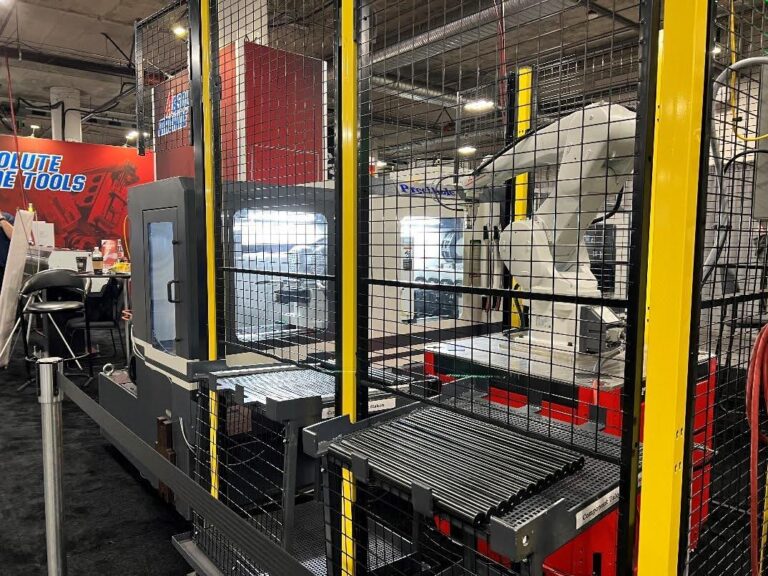
Swiss-type lathes are among the most natural machine tending candidates in any CNC shop. Bar feeders already advance stock automatically, and the guide bushing keeps parts stable through the cut. A Swiss lathe with a bar feeder and a cobot for part removal covers the full cycle: raw bar stock in, finished part out, unattended.
Turning centers follow similar logic for chucking work. A cobot loads blanks into the chuck, the machine runs the cycle, and the cobot unloads the finished part. Consistent chuck-open and chuck-close M-codes are standard on most modern turning centers, making integration straightforward.
Vertical machining centers are the most common mill tending robot application. A mill tending robot loads a fixture, starts the cycle, and unloads after machining — turning a one-operator-per-machine setup into a one-operator-per-cell configuration. With an auto door kit handling the machine door automatically, VMCs can run through overnight shifts without an operator present.
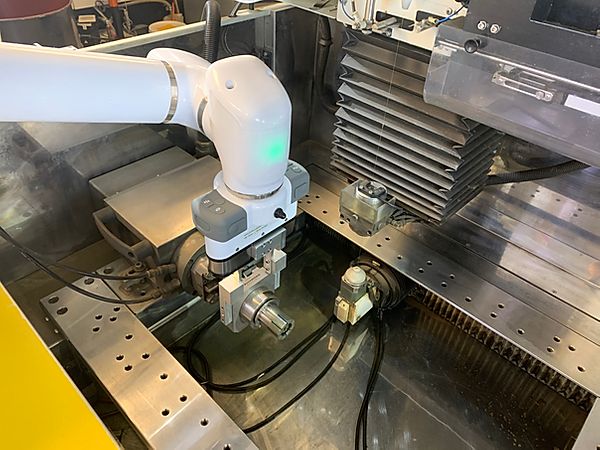
Wire EDM machines are particularly well suited for machine tending because they require no cutting force, produce minimal chips, and run long, predictable cycles. True Precision Machining added an OB7 to their wire EDM and finished a 500-part job in 3.5 days — a job that previously took a full week. Read the True Precision case study →
High-Mix Shops and Short Runs: What About Changeovers?
The most common objection from job shops is that machine tending only works for high-volume production. BIC Precision runs batches of 500 to 7,000 parts and has an OB7 tending two Doosan lathes, including secondary operations. Read the BIC Precision case study →
The key is the teach platform. The OB7 from Productive Robotics requires no programming. An operator physically moves the arm through the task to teach each position: pick location, load position, door clearance, deposit point. Changing to a new part means teaching a new routine, which takes minutes rather than hours. The OB7 stores multiple routines, so returning to a familiar job is a single selection.
For shops running dozens of part numbers in small batches, the teach platform is what makes machine tending practical. A cobot that requires a programmer to deploy is not a realistic tool for a high-mix shop. One that an operator can teach in minutes is.
One Cobot, Multiple Machines
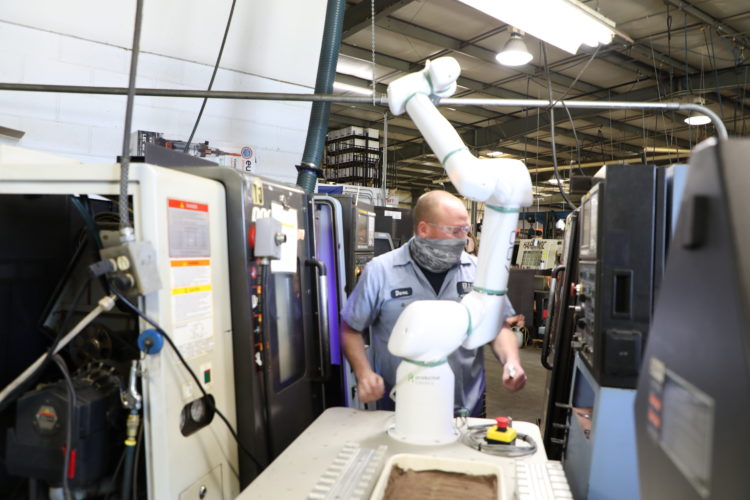
One of the strongest economic arguments for machine tending is the shift from one-operator-per-machine to one-operator-per-cell. A single cobot can tend two or three machines if their cycle times allow it: the cobot loads Machine A, moves to unload Machine B while A runs its cycle, then returns to A when B’s cycle completes.
BIC Precision’s operator, who previously tended one machine full time, now runs two additional machines simultaneously. Swiss Productions added a second OB7, and their operator now oversees the full cell rather than standing at one machine. Read the Swiss Productions case study →
The math favors multi-machine tending when machines are close together and cycle times are similar. When one machine’s cycle time significantly exceeds the cobot’s load/unload time, the cobot is available to serve a second machine during that window at no additional labor cost.
Is CNC Machine Tending Safe?
Cobots are specifically designed to share workspace with human operators. They operate under power-and-force limits defined by ISO/TS 15066, the international standard for collaborative robot operations. In collaborative mode, the cobot’s speed stays at or below 250mm per second (approximately 10 inches per second), which limits the force of any contact with an operator to safe levels.
The practical result: a cobot machine tending cell typically does not require safety fencing. This is a significant operational and cost difference from traditional industrial robots, which require full guarding and exclusion zones.
A risk assessment is still required before deployment regardless of regulatory status. The assessment identifies entanglement hazards (loose clothing, gloves, hair), electrical hazards, and any geometric pinch points in the cell layout, and documents what risk reduction measures are in place.
Absolute’s automation engineers build risk review into every integration project. The complete cobot implementation guide covers the full risk assessment process.
Cobot vs. Industrial Robot for CNC Machine Tending
|
Factor |
Cobot (e.g., OB7) |
Industrial Robot (e.g., LoadMate Plus) |
|---|---|---|
|
Typical payload |
Up to 10 kg |
10 kg and above |
|
Safety fencing required |
Typically no |
Yes, in most configurations |
|
Programming |
Teach by demonstration, no code |
Requires programming expertise |
|
Floor space |
Compact, flexible placement |
Larger footprint, fixed cell |
|
Changeover to new part |
Minutes |
Hours |
|
Best for |
Job shops, medium parts, high-mix |
High-volume, heavy parts, multi-machine cells |
|
Integration complexity |
Lower (MIU simplifies further) |
Higher |
Cobots dominate new machine tending deployments for parts under 10 kg. For heavier parts, high-volume production cells, or applications requiring greater speed and throughput, an industrial robot or hybrid solution is worth evaluating.
CNC Machine Tending Solutions from Absolute Machine Tools
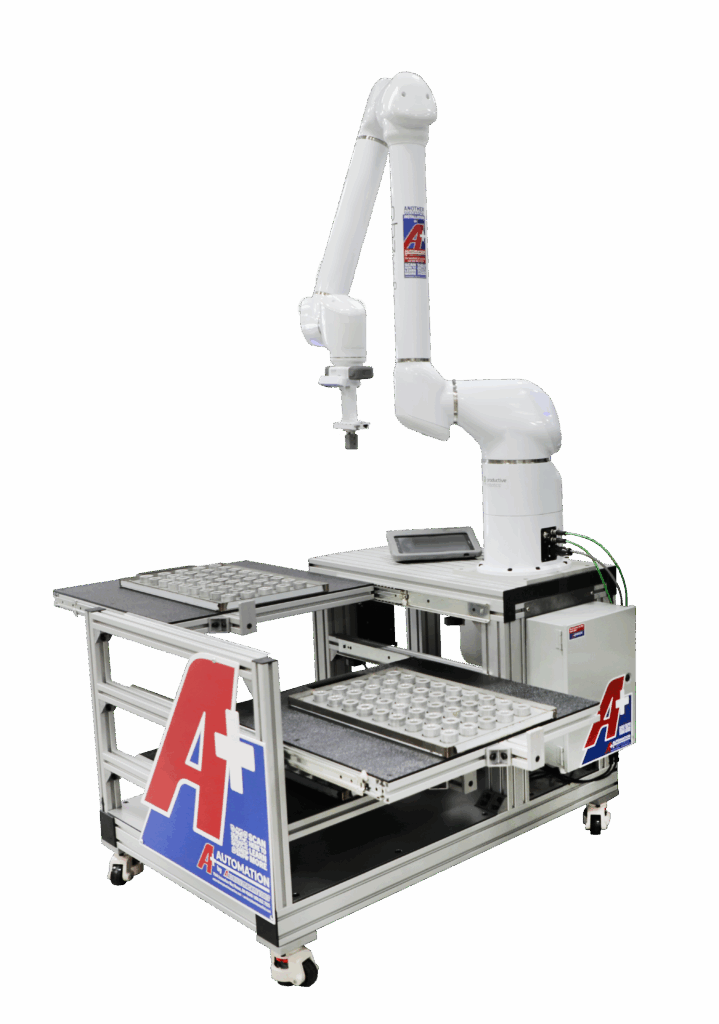
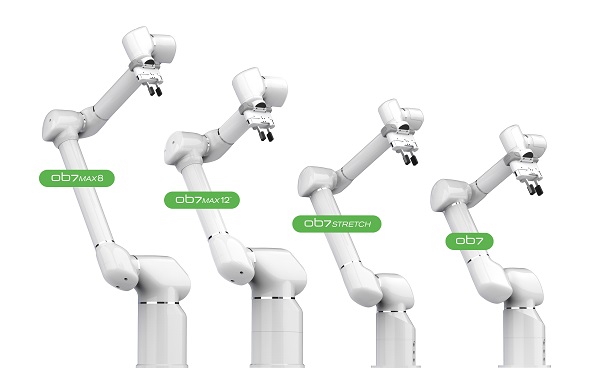
The OB7 cobot from Productive Robotics is Absolute’s top machine tending solution. The 7th axis allows the arm to approach the machine from the side rather than directly in front of the door — keeping operator access clear during attended shifts and making side-door placement practical in tight shop layouts. No programming is required; operators teach the OB7 by physically moving the arm through the task. The OB7 stores multiple routines, making changeover between part numbers a straightforward process.
FANUC CRX collaborative robots are available for machine tending applications requiring higher payload or more complex cell configurations. As an authorized FANUC integrator, Absolute’s automation engineers design, install, and support FANUC robotic systems for CNC machine tending across control brands and machine types.
The LoadMate Plus from Mitsubishi Electric is designed for shops running multiple machines or heavier parts that exceed a cobot’s payload range. It extends machine tending to larger components and multi-machine production cells.
The Master Interface Unit (MIU) connects any of these solutions to virtually any CNC machine without custom M-code programming or ladder logic modification. For shops with older machines or limited in-house engineering resources, the MIU significantly reduces integration time and cost for most standard machine tending applications.
What a Complete Machine Tending Cell Requires
The cobot is one component. Before the first cycle runs, the following also need to be in place:
- End-effector (gripper). The device the cobot uses to pick and place parts. Matched to part geometry, weight, and material. Pneumatic grippers are most common for production machine tending.
- Part staging and fixturing. A tray, chute, conveyor, or custom fixture that holds raw parts in a consistent location and orientation for the cobot to pick from. Fixturing is frequently underestimated in both time and cost.
- Auto door kit. For lights-out or semi-attended operation, an auto door kit opens and closes the CNC machine door automatically as part of the tending cycle. Without it, an operator must be present for every cycle. See the lights-out manufacturing guide for guidance on building a full unattended cell.
- CNC integration. M-code communication between the cobot and the CNC control, or the MIU as a simplified alternative for most standard applications.
- Maintenance routine. A daily pre-shift checklist covering cobot joints, cable connections, end-effector mounting, and chip/coolant buildup.
The complete cobot implementation guide covers all eight steps from workspace assessment through go-live.
Real-World CNC Machine Tending Results

Swiss Productions — Ventura, California
A precision screw machine shop getting 9 hours of daily production from their Haas Mill, with an operator loading and unloading every 7-8 minutes. After adding OB7 cobots, production reached 76 hours per week — adding 32 hours of unattended production plus time recovered during breaks. A second OB7 has since been added, and the operator now oversees the full cell. Read the case study →
True Precision Machining
An OB7 cobot added to a wire EDM machine tending cell allowed a 500-part job to be completed in 3.5 days instead of a full week, running lights-out through nights and weekends. Read the case study →
BIC Precision
A small job shop with batches of 500 to 7,000 parts added an OB7 tending two Doosan lathes including secondary operations. The machinist who previously tended one machine now runs two additional machines simultaneously. Read the case study →
CNC Machine Tending FAQs
Ready to Automate Your CNC Machine Tending?
Absolute’s automation engineers work with manufacturers across Ohio, Indiana, Kentucky, and nationwide to design, integrate and support CNC machine tending cells, from a single cobot on one machine to full multi-machine production cells.