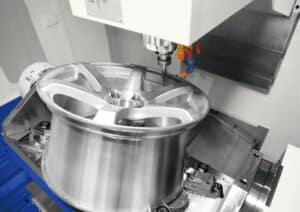
CNC Wheel
Machines

CNC Wheel Machines for Tier One Automotive Production

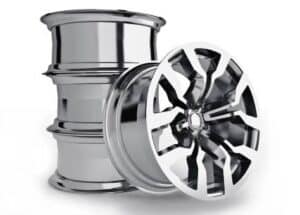
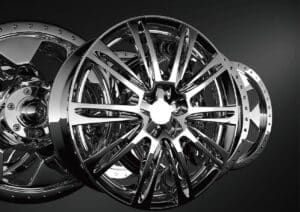
Manufacturing finished wheels involves several steps and componentry. Often wheels are mistakenly referred to as hubs or rims depending on the conversation. However, finished wheels consist of hubs and rims because they are all machined simultaneously within the same cutting process. So, it’s understandable how the 3 terms can be used interchangeably.

Finished wheel componentry consist not only of the hubs and rims but also items such as wheel covers, hubcaps, center caps, spokes, valve stem hole, bearings, and bolts/lug nuts. The rim flange is the outer edge of the rim that prevents the rubber wheels from slipping off while the vehicle is in motion. The bead seat is located on the rim ensuring the tire maintains sufficient air pressure and doesn’t go flat. Both the rim flange and bead seat are not listed under additional componentry because they are machined on the wheel during the initial cutting process, just like the rim flange and bead seat. Finally, the wheel hub mounting area, or hub flange, is located on the axels and allows the wheel to be bolted onto the vehicle’s axels.   

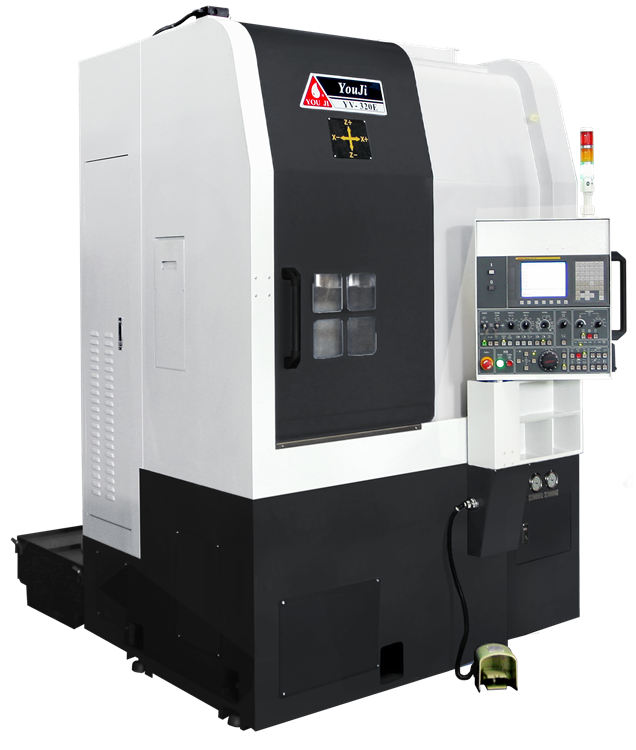
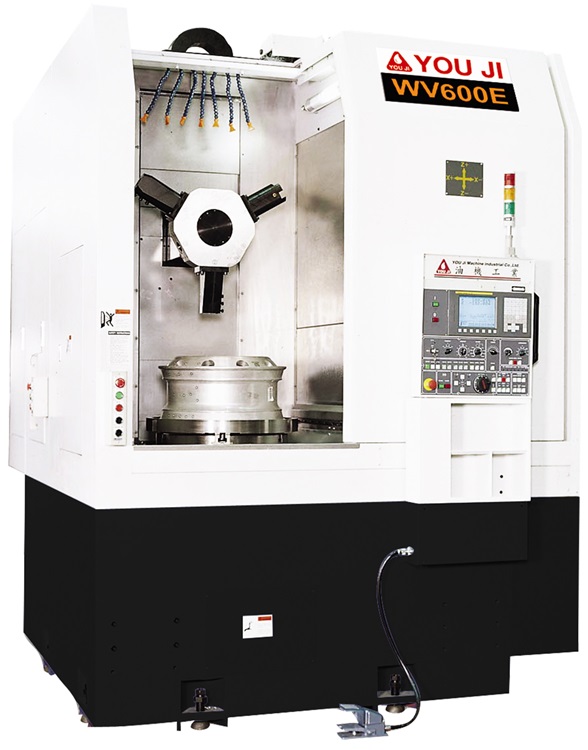
There are many factors to consider when machining quality wheels, whether it be in mass-production or repairing single units. You Ji’s WV wheel machine series and YV vertical turning series have been producing wheels for more than 20 years. Both are interchangeable in either an automated cell consisting of multiple machines, or a single machine operation. You Ji CNC wheel machines have turned millions of wheels around the world for various Tier One companies that supply wheels to top automotive manufacturers.

Machines
General Steps Taken to Produce a Single Wheel

  1. Material selection: Choose a suitable metal material for the wheel hub based on the requirements of your application, such as strength, durability, and compatibility with the vehicle. Common choices include steel, aluminum, or cast iron.
  2. Design and planning: Determine the dimensions, specifications, and features of the wheel based on the vehicle’s requirements. Consider factors such as bolt hole patterns, flange diameter, overall diameter, and any additional features required.
  3. Material preparation: Obtain a metal stock or raw material in or close to the size that matches the dimensions of the desired wheel hub. Ensure the material is suitable for machining.
  4. Set up the lathe: Mount the metal stock securely onto the chuck of the machine. Ensure it is properly centered and aligned to prevent vibrations or inaccuracies during the turning process.
  5. Roughing: Use appropriate cutting tools, such as lathe tools or end mills, to remove excess material and create the basic shape of the wheel. Roughing cuts help remove bulk material quickly and efficiently.
  6. Turning: Use a cutting tool, such as a lathe tool or boring bar, to shape the outer diameter, inner diameter, and any other surfaces of the wheel. Follow the dimensions and specifications required for proper fitment.
  7. Drilling: Use suitable drills to create the bolt holes on the flange of the wheel. Ensure the hole size, spacing, and alignment match the specifications required for proper fitment.
  8. Finishing: Use cutting tools, such as chamfering tools or deburring tools, to remove any sharp edges, burrs, or imperfections from the machined surfaces. This step helps ensure a smooth and safe wheel.
  9. Quality inspection: Thoroughly inspect the turned wheel hub for dimensional accuracy, surface finish, and any other specifications required. Use measuring tools, such as calipers, micrometers, gauges, or even lasers to verify that the hub meets the desired tolerances.
  10. Post-machining treatment: Depending on the material chosen, you may need to perform additional treatments like heat treatment, surface coating, or corrosion protection to enhance the wheel’s properties and durability.
  11. Installation: Once the turned wheel has passed all quality inspections and treatments, it can be installed on vehicles following the manufacturer’s recommended procedures. Ensure proper torque settings and alignment during installation.

The Absolute Advantage:

  1. Unmatched Expertise: With years of experience in the automotive industry, we have in-depth knowledge of the challenges you face. Our team of experts is dedicated to understanding your specific needs and providing customized solutions that drive your success.
  2. Cutting-Edge Technology: We stay at the forefront of technological advancements in the automotive industry. By partnering with us, you gain access to the latest innovations that enhance your manufacturing capabilities and give you a competitive edge.
  3. Superior Quality & Reliability: At Absolute Machine Tools, quality is our top priority. We partner with renowned manufacturers known for their precision and reliability. Our machines undergo rigorous testing to ensure they meet the highest standards, guaranteeing exceptional performance and longevity.
  4. Comprehensive Support & Training: We don’t just provide machinery; we provide complete support and training to ensure your team is fully equipped to leverage our solutions effectively. Our experienced technicians are always available to provide assistance, training, and ongoing support, ensuring optimal performance and minimal downtime.

Partner with Absolute Machine Tools Today

When it comes to automotive manufacturing excellence, Absolute Machine Tools is the partner you can trust. We are committed to helping you achieve operational efficiency, maximize productivity, and stay ahead in the competitive automotive industry. Complete the form below to contact us today to learn more about our cutting-edge machinery and customized solutions tailored to your unique needs. Together, let’s drive success in the automotive manufacturing landscape.
Frequently Asked Questions About CNC Wheel Machines

A CNC wheel lathe — sometimes called an alloy wheel lathe — is a vertical turning machine built around one specific job: clamping a wheel casting or forging in the chuck, then machining the hub face, both rim diameters, and the bead seats without ever breaking that clamp. Holding the part through the entire cycle is the point — repositioning a wheel between operations risks throwing the hub bore and rim slightly out of concentricity with each other, which shows up later as vibration at highway speed. You Ji’s WV series is built specifically around high-volume aluminum wheel production, with a rigid, heavily ribbed one-piece casting rather than the general-purpose design of a standard vertical turning center or lathe.

Both machine wheels, but for different production profiles. The WV series is the dedicated wheel platform, built specifically for high-volume aluminum wheel runs — the kind a Tier One supplier needs when a line has to turn out the same wheel design over and over. The YV series is a general-purpose vertical turning center line that also handles wheels. Its wider range of sizes and tooling options (hex turret, drum turret, gang tooling or automatic tool changer, with live milling available on some models) trades some of the WV’s wheel-specific focus for flexibility. That suits shops running mixed wheel programs, larger wheels, or wheels alongside other large turned parts. A supplier dedicated to one or two wheel programs typically leans WV; a shop switching between wheel designs or handling other work on the same machine usually leans YV.

Tier One wheel suppliers typically run WV or YV machines inside automated cells rather than as standalone units — a robot or gantry loader feeds rough castings in and pulls finished wheels out, so one operator can tend several machines through an unattended shift. That matters because wheel programs run in the tens of thousands of units, and the labor cost of manually loading a chuck that many times would erase the margin on the job. Absolute’s CNC automation solutions integrate with the WV and YV lines the same way they do across the rest of its automotive industry lineup, with optional part probing available on YV models to catch an out-of-tolerance wheel before it leaves the machine.

Diamond cutting is a finishing pass, not a separate machine category. It’s the same CNC wheel lathe running a diamond-tipped tool at a much lighter depth of cut than the roughing passes used to shape the wheel. Instead of removing bulk material, the tool skims a hair’s-width layer off the face of an already-formed wheel to expose bright, unpainted aluminum underneath, which is what creates the two-tone look on a lot of OEM and aftermarket alloy wheels. Because the cut has to track the wheel’s exact contour, the lathe typically scans or probes the face first so the program follows the real part rather than a nominal CAD model. A single WV- or YV-class machine can run diamond-cut passes on new production wheels or on wheels being refinished, which is one reason the same machine platform serves both OEM lines and repair shops.

Chuck and swing capacity should be the first filter. Passenger wheels typically run 14″ to 24″+ in diameter, while light truck and off-highway wheels can be considerably larger, so match the machine’s turning diameter and hub bore range to what you’ll actually run. Beyond size, decide whether the job calls for a dedicated single-purpose platform like the WV series or a more flexible turret-type machine like the YV series, and whether volume justifies robotic loading versus manual chucking. Repair and refinishing shops usually prioritize fast changeover and diamond-cut capability over raw throughput, while OEM and Tier One lines weight cycle time and automation compatibility more heavily. If your parts extend beyond wheels into other large turned components, it’s worth reviewing Absolute’s full lineup of CNC turning centers and lathes rather than a wheel-only platform.

Yes. A forged wheel blank typically starts with more excess material than a near-net-shape casting, so the machine is removing more material and doing more of the work on the lathe, which typically means longer cycle times and closer attention to chip control. A forging press compresses the aluminum’s grain flow to follow the wheel’s shape before machining ever starts. That denser structure is part of why forged wheels can end up lighter and stronger at the same wall thickness, but it also means roughing passes are cutting through tougher, less porous material than an equivalent cast wheel. Cast wheel designs also tend to stay geometrically simpler, since the mold has to fill completely and release cleanly, while forged blanks can support the thinner spokes and sharper detail that machining brings out afterward. A CNC wheel lathe handles both, but tooling and feed rates get dialed in differently depending on which blank is on the chuck.

Yes. A turret-type machine like the YV series is a natural fit here, since the extra tool stations make it practical to switch between wheel programs without a full retool — exactly what a custom or aftermarket wheel shop needs when running small batches of different designs. For wheels with more elaborate spoke work or off-axis features than turning alone can reach, YV models equipped with live milling can cut those details without moving the part to a second machine. Custom rim shops producing forged or semi-forged wheels in short runs typically value that flexibility more than the raw cycle-time advantage a dedicated production platform offers.

Absolute Machine Tools sells the You Ji WV and YV wheel machine lines directly and keeps a portion of its 150+ machines in stock in the U.S., which matters for wheel producers because import delays on a production-critical machine can stall a line for months. Contact Absolute directly to check current WV and YV availability, get pricing based on your wheel size range and production volume, and discuss whether a standalone machine or a fully automated cell fits your application better.

Wheels sold in the U.S. are commonly tested against SAE standards, while wheels sold into Japanese and other international markets are tested against JWL (Japan Light Alloy Wheel) and VIA, and often carry TÜV SÜD lab reports referencing those same protocols. SAE testing covers radial fatigue, cornering fatigue and impact, and JWL adds a roundness requirement a wheel must meet to pass. Meeting those specs starts on the lathe: a rigid vertical turning platform, a chuck that holds the wheel true through the full cut, and a machine that doesn’t drift out of accuracy over a multi-thousand-unit run are what keep runout within tolerance long before the wheel ever reaches a test lab. It’s one reason Tier One wheel programs specify machine rigidity and repeatability up front rather than treating the lathe as a commodity purchase.

The difference is purpose and configuration, not machine architecture. The WV and YV wheel machines are still fundamentally vertical turning platforms, the same family as Absolute’s broader vertical turning centers and lathes lineup, but both have more than 20 years of wheel production behind them and are built to run as single machines or inside automated, multi-machine wheel cells. The WV is focused entirely on high-volume aluminum wheels, while the YV pairs that proven wheel capability with the tooling flexibility to handle other turned parts. Absolute’s other vertical lathes are sized for a much wider range of large, heavy or irregularly shaped parts, with more flexible tooling to match. A shop that only runs wheels gets the most value from the WV or YV. A shop where wheels are a smaller share of a broader mix of flanges, rings or other large turned components is usually better served by the general-purpose lineup, configured for wheel work as one application among several.

Yes. A standalone WV or YV machine works as well for a repair or refinishing operation as it does inside an OEM cell; the difference is how it’s used, not the machine itself. A repair shop is typically running one wheel at a time through re-turning, correcting curb damage, or a diamond-cut refinish, so changeover speed and ease of programming matter more than the cycle-time optimization an OEM line is chasing. Because the same chuck-and-turn architecture handles both mass production and single-unit work, a shop can start with one machine sized to the wheel diameters it sees most often and scale into automation later if repair volume grows.

Videos

Pictures

REQUEST INFORMATION

This field is for validation purposes and should be left unchanged.
Name(Required)
Company(Required)