Horizontal
CNC Lathes

Horizontal Turning Center

Absolute Machine Tools offers an extensive horizontal turning center selection, ranging from heavy-duty powerhouses to efficient production-style machines, from leading brands Johnford, Tongtai, and You Ji. Elevate your productivity by incorporating automation into these machines through our standard built-in options or cutting-edge cobots from Productive Robotics.

Our horizontal CNC lathes are designed to streamline your workflow with a host of features, including automatic pallet shuttles with multiple rotary and stacking-type pallets, gantry loaders, parts stockers, side-type robots, workpiece turnover and change units, plate-type conveyors, and bar feeders. Additionally, we are proud to be recognized as authorized integrators for FANUC and Mitsubishi robotics, ensuring seamless integration of robotic systems into your operations.

Check out our diverse range of horizontal turning centers below and contact us today to request a quote.

Is a sub-spindle worth the investment?

A sub-spindle is a second, independently driven spindle mounted opposite the main spindle — often on the Z-axis slide — that accepts a partially machined part handed off from the main spindle while it’s still precisely located. Once the handoff occurs, the sub-spindle can perform turning, drilling, threading, or milling operations on the back end of the part using its own turret or the main turret, depending on machine configuration.

The economic case for a sub-spindle centers on the cost of re-chucking: every time an operator manually repositions a part onto a second machine, they introduce handling time, setup time, and the potential for runout caused by imperfect re-location.

On a part running at high volume — say, a hydraulic fitting with turned features on both ends — a sub-spindle typically cuts the per-piece labor cost in half and eliminates re-fixturing entirely, often justifying the premium over a basic two-axis machine within months of installation. Combined with a bar feeder, a sub-spindle-equipped turning center can run lights-out through an entire shift, completing parts start-to-finish with no operator intervention.

What automation options are available for horizontal turning centers, and how do I know if my shop is ready?

Horizontal turning centers are among the most automation-friendly machine tools in a shop because the horizontal spindle orientation is well-suited for a range of loading approaches — gantry loaders, robot cells, bar feeders, parts catchers, and plate-type conveyors can all be integrated depending on part geometry and batch characteristics.

For bar stock work, a bar feeder (6′, 10′, or 12′) feeding through the spindle bore is the simplest and lowest-cost automation path, enabling unmanned production of turned parts from stock to finish.

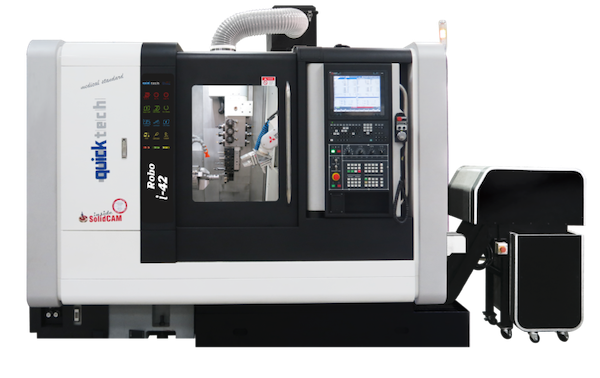
For chucked parts that arrive pre-cut, a cobot or 6-axis robot mounted beside the machine handles load/unload with flexible programming that accommodates multiple part families.

Absolute is an authorized integrator for both FANUC and Mitsubishi robotics, and offers cobot packages from Productive Robotics specifically sized for turning center tending.

A shop is typically ready for automation when it can identify at least one part family running in batches of 50+ pieces with predictable cycle times — that consistency is what allows unattended operation to actually deliver ROI.

For very small parts or complex secondary operations, consider whether CNC Swiss lathes or mill-turn centers with integrated automation might be a more efficient solution for those specific geometries.

Machines
Horizontal (Slant Bed) Turning Centers

10″+ Chuck Turning Centers and Lathes

Horizontal (Flat Bed) Turning Centers

Super large, heavy duty, high precision FLAT BED Lathes

Multitasking Turning Centers

Sub-spindle, Multi-turret Turning Centers and Lathes

Turning Centers – Automation (Auto Loading)

Integrated Automated Loading and Unloading Systems including Robotics

Videos

Frequently Asked Questions About Horizontal Turning Centers

A horizontal CNC turning center is a computer-controlled machine that rotates a workpiece on a horizontal spindle while cutting tools remove material to produce cylindrical, conical, or threaded features — but the “turning center” designation signals something more than a conventional lathe.

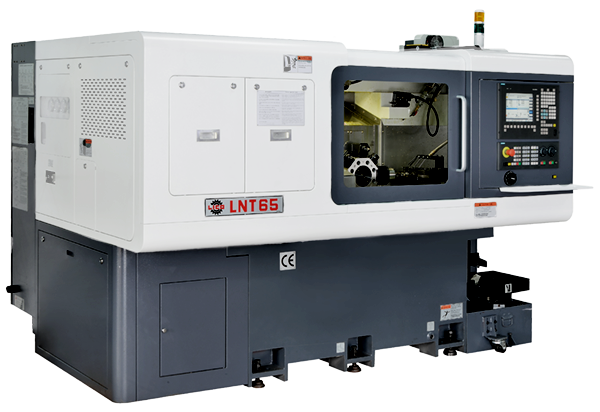
Where a basic CNC lathe operates on two axes (X and Z) and can only turn diameters and face ends, a full turning center typically adds a C-axis for spindle positioning, live-tool capability for driven milling and drilling operations, and often a Y-axis for off-centerline features — effectively compressing what used to require a lathe and a machining center into a single clamping.

The practical difference at the shop floor level: a lathe produces a turned blank that still needs secondary operations elsewhere, while a turning center can deliver a finished or near-finished part from raw stock in one setup.

The bed geometry is the most consequential structural decision in a turning center, and the choice maps closely to the type of work a shop runs.

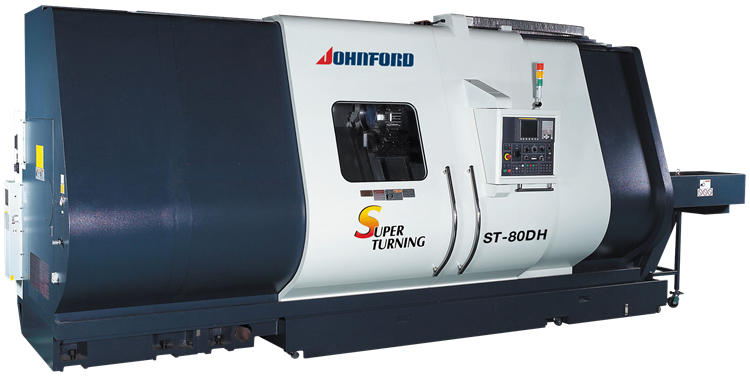
Slant bed lathes — typically inclined at 30°, 45°, or 60° — pack more X-axis travel into a compact footprint, allow chips and coolant to clear the cutting zone continuously, and provide superior rigidity for live-tool and high-speed production work. Their geometry means the cutting forces act more in alignment with the machine’s structural mass, reducing the vibration that degrades surface finish and tool life.

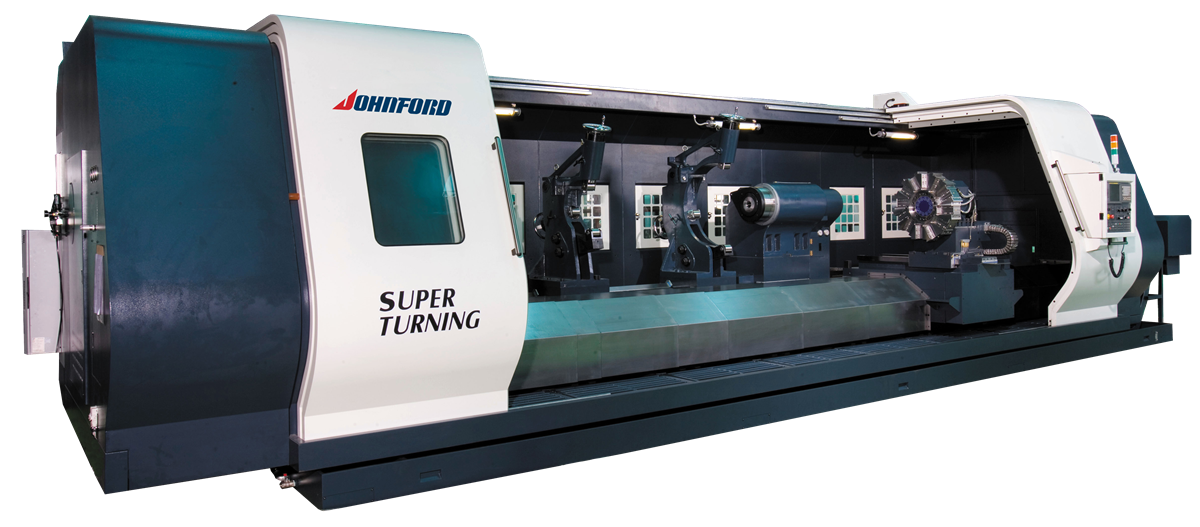
Flat bed lathe designs, by contrast, prioritize raw structural capacity: a wider, lower casting that can accommodate very large-diameter swings, long between-centers distances, and heavy spindle torque requirements for deep roughing cuts.

For shops turning oil country tubular goods, large-bore hydraulic cylinders, or heavy shaft work measured in feet rather than inches, flat bed machines like the Johnford LC Series offer the rigidity and swing clearance that slant bed geometry physically cannot match at the same price point.

The better question for a modern horizontal turning center is what you can’t do — because the list of what stays on the machine is long. Beyond turning operations like OD/ID roughing, finishing, threading, taper turning, and grooving, a turning center equipped with a live-tool turret can handle radial and axial drilling, tapping, milling flats, slotting, and boring off the centerline — all without the part leaving the chuck.

Adding a Y-axis extends that capability to cross-holes at any XZ position, eccentric features, and contoured milled profiles that a C-axis alone can’t reach.

The practical result: a connecting rod that once visited a lathe, a drill press, and a VMC can often be completed in two operations on a single turning center — or in one operation with a sub-spindle handling the second end.

For shops routing complex turned parts across three or four machines, consolidating that workflow onto one machine removes the accumulated positioning error of multiple setups and typically cuts lead time substantially.

Horizontal and vertical lathes address fundamentally different workpiece geometries rather than competing directly. Horizontal turning centers dominate production of shafts, bars, tubes, and axisymmetric parts where length-to-diameter ratio is the defining characteristic — and where a bar feeder can load raw stock automatically.

The horizontal spindle orientation also makes gravity work in your favor for chip evacuation, which keeps the cutting zone cleaner during continuous production runs.

Vertical configurations — including VTL lathes — excel when a part is short, heavy, and large in diameter: think flanges, brake rotors, turbine rings, and large bearing races. These parts are difficult to load horizontally because their weight exceeds what a chuck can safely grip against the spindle’s axial direction; standing them upright on a vertical chuck lets gravity stabilize the workpiece rather than fight the workholding.

If your shop regularly handles both shaft-type parts and short, disc-type components, you likely need both configurations — or a mill-turn center that can approach certain geometries from either orientation.

Horizontal turning centers are among the most broadly applied machine tools in manufacturing precisely because rotational symmetry shows up in virtually every sector.

Automotive driveline components — axle shafts, transmission gears in the blank stage, crankshafts — represent some of the highest-volume applications, where cycle time per part and tool life are the dominant cost factors.

Aerospace uses horizontal turning centers for landing gear actuator shafts, fastener blanks, and engine component roughing before grinding.

The energy sector depends heavily on large-bore horizontal turning for valve bodies, wellhead components, drill collar blanks, and API-threaded tubular goods, where spindle bore size and torque at low RPM matter more than speed.

Medical device manufacturers run horizontal turning centers for bone screws, spinal implant components, and surgical instrument shafts, where the combination of tight tolerances and very small batch sizes demands quick changeover between setups.

General job shops rely on horizontal turning as their core turning capability — a well-specced machine with live tooling handles the majority of cylindrical work that walks through the door.

The distinction shows up at the intersection of spindle bore diameter, torque at low RPM, casting mass, and way system design.

A standard production slant bed turning center might carry a 3″ spindle bore, a 15–25 HP spindle, and linear guide ways optimized for speed and precision at medium cutting loads. A heavy-duty flat bed or large-bore turning center — like the Johnford LC Series or the You Ji AH Series — is engineered from the ground up for a different problem: turning stock measured in feet of diameter or carrying sections of large-diameter pipe and tubing through the spindle bore.

The You Ji AH Series, for example, features a 60 HP spindle with dual double-row roller bearings delivering torque up to 3,154 lb./ft. at just 100 RPM — the low-speed, high-torque profile that oil and gas turning demands. A 3-speed geared head paired with thermal isolation of the coolant tank addresses the sustained heat generation of deep roughing cuts over long cycles.

Shops in oil and gas, construction equipment, and heavy industrial manufacturing buy these machines specifically for workpieces that would overload a conventional turning center’s spindle bearings and way system within the first few cuts.

A dedicated horizontal turning center typically wins when the majority of your production volume is turning-dominant work — parts where milling, drilling, or off-centerline features represent a small fraction of total cycle time. If 80% of a part’s cycle is turning and 20% is drilling two cross-holes, a horizontal turning center with live tooling handles that efficiently without the investment or programming complexity of a full multi-axis mill-turn machine.

Mill-turn centers become the stronger choice when the milling content is substantial — complex prismatic features, angled tool paths, B-axis work, or simultaneous multi-axis contouring — because a turning center’s live-tool spindle typically lacks the rigidity and power of a dedicated machining spindle for sustained heavy milling.

The cost differential between a well-equipped horizontal turning center and a 9- or 10-axis mill-turn center can be significant, and that premium only pays off if the milling work fills the machine’s capability. The right question isn’t which machine is more capable — it’s which machine matches your actual part mix without buying capability you won’t use.

Absolute carries horizontal turning centers from two long-standing OEM partners, each covering a distinct application range.

Johnford machines — including the ST, HT, GT, and LC flat bed series — are built for heavy-duty work, with box way construction, gearbox spindles up to 133 HP, and between-center distances extending to 788″ for shaft and roll turning.

You Ji fills the oil country and heavy-bore segment with the AH Series, a 45° slant bed design specifically engineered for the torque and bore requirements of energy sector turning.

Absolute has maintained direct relationships with all three manufacturers for over 20 years, stocks machines domestically to avoid tariff delays, and maintains a $20M+ parts inventory to minimize downtime after installation.

Buyers evaluating smaller-diameter precision turning work may also want to consider Absolute’s CNC Swiss lathes from Nexturn, which address bar work in the 12–56mm range with multi-axis capability.

REQUEST INFORMATION

This field is for validation purposes and should be left unchanged.
Name(Required)
Company(Required)