Swiss
Lathes
Swiss Lathes
Precision production turning solutions for intricate high-volume parts dropped complete.
Swiss-type CNC lathes are engineered for precision production turning of intricate high-volume parts that are dropped complete in a single cycle. These machines use a sliding headstock design with a guide bushing to support the workpiece close to the cutting tool, allowing for exceptional accuracy, fine surface finishes, and superior concentricity on long slender components.
Absolute Machine Tools has represented Nexturn for two decades, providing manufacturers across North America with dependable, cost-effective precision turning solutions. Nexturn CNC Swiss lathes are engineered for speed, rigidity, and reliability—offering 7- to 11-axis configurations, 2- and 3-Y-axis models, and up to 3 simultaneous machining channels for maximum flexibility and productivity.
CNC Swiss Lathes Series
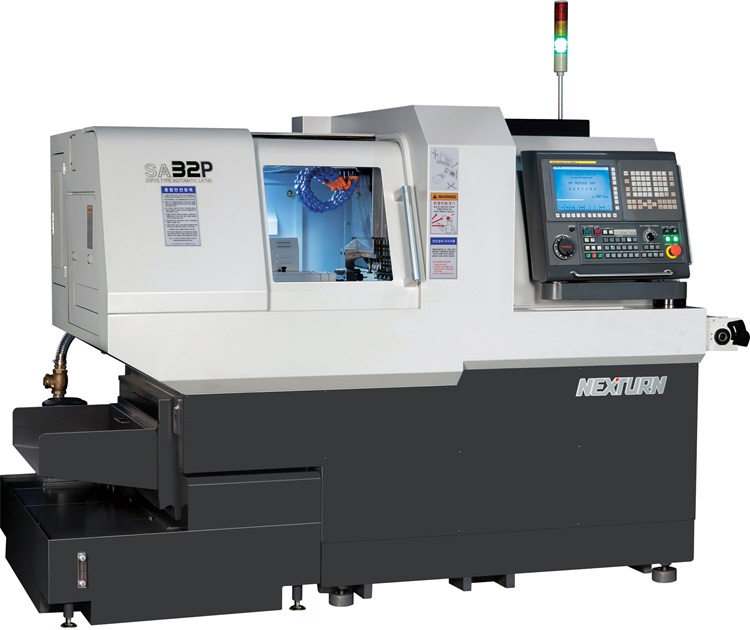
| B Series | 7-Axis Industry-Leading Efficient Model with 22 Tools |
| PII Series | 7-Axis Performance Model with 23 Tools, Exchangeable Guide Bushing & Modular Rotary Spindles |
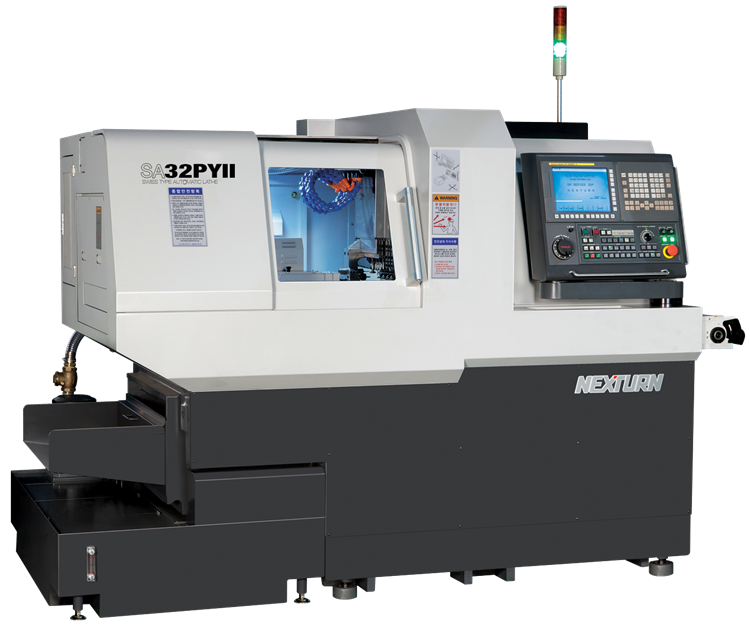
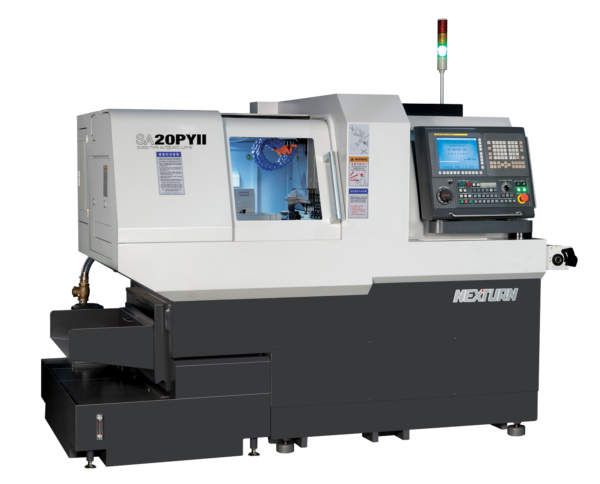
| PYII Series | 8-Axis Performance Model, Dual Y-Axes, 27 Tools, Exchangeable Guide Bushing & Modular Rotary Spindles |
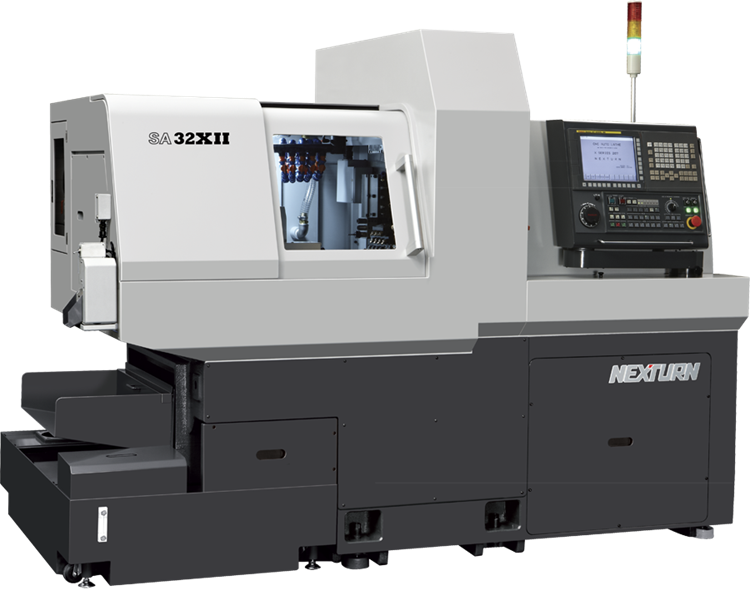
| XII Series | 8-Axis Advanced Model Plus Optional B-Axis, 33 Tool Capacity, Exchangeable Guide Bushing & Modular Rotary Spindles |
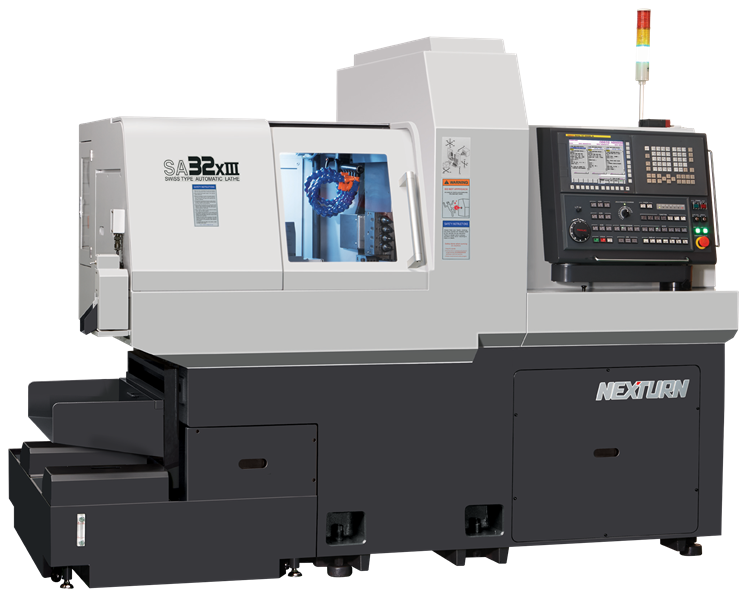
| XIII Series | 11-Axis Advanced Model with 3-Channel Dual Opposed Gang Tool Post, 33 Tools, Exchangeable Guide Bushing & Modular Rotary Spindles |
Nexturn Swiss Lathes Are Available with the Servo Learning Oscillation Option!
The Servo Learning Oscillation feature from Fanuc is available to prevent chip challenges manufacturers may experience when working with hard-to-machine materials. If you’ve had issues with long stringy chips creating a bird’s nest around your part during the cutting cycle, this option is the solution! This feature breaks the chips by constantly changing frequencies through the X, Y, and Z axes.
Machines
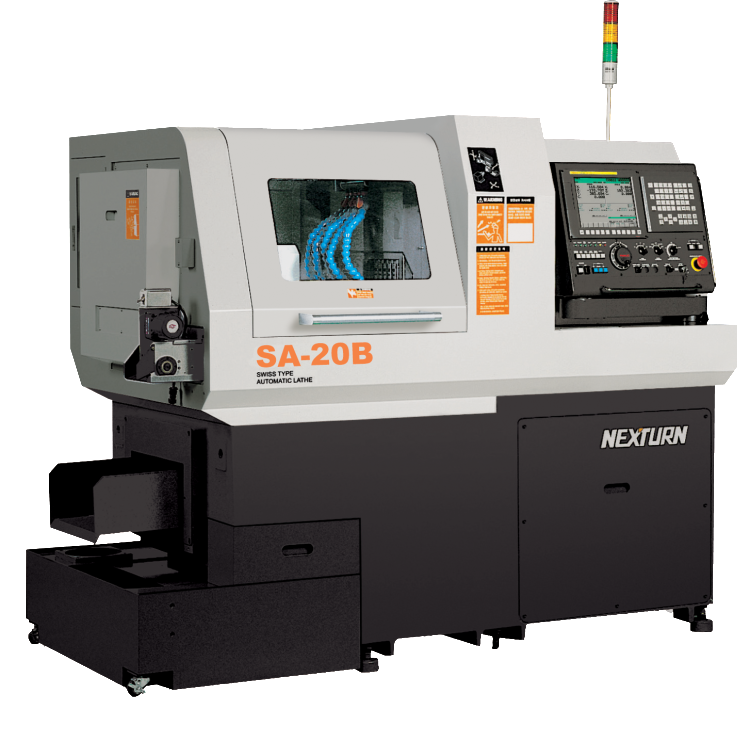
11-Axis Swiss Lathes, 33 Tools, 3 Channels, 3 Y-Axes & Exchangeable Guide Bushing
Proud Technical Member of the Precision Machine Products Association

Benefits for Metal Cutting Manufacturers
Solutions from Absolute Machine Tools
Nexturn Swiss Lathes
Absolute Machine Tools is the exclusive North American distributor of Nexturn Swiss-type CNC lathes, including the B Series, PII Series, PYII Series, XII Series, and XIII Series. Each series is engineered for precision, speed, and productivity — ideal for producing small, complex components that demand accuracy and repeatability.
Every Nexturn machine is packaged with a matching hydrodynamic magazine bar feeder (6’, 10’, or 12’) at no additional cost, enabling uninterrupted, lights-out production for high-volume operations. The optional Servo Learning Oscillation feature — also known as chip-breaking — prevents long, stringy chips from wrapping around parts when cutting difficult materials, while maintaining excellent surface finishes and dimensional accuracy.
Take Production Turning to the Next Level
Absolute Machine Tools backs every installation with dedicated Production Turning specialists and factory-trained service technicians who understand Swiss machining from the operator’s perspective. From turnkey setups to automation integration, Absolute ensures each Swiss lathe performs at its peak from day one.
Contact our Production Turning team today to discuss your application, schedule a demo, or request a turnkey automation proposal designed to improve your output and profitability.
Frequently Asked Questions About Swiss Lathes
What is a Swiss-type lathe?
Swiss type lathes are a specialized type of Swiss CNC lathe. Swiss lathes are designed for machining small, complex parts with a high degree of accuracy. They typically have a diameter capacity of less than 20 mm (0.79 in) and can operate at extremely high speeds, making them well suited for machining high precision parts. For bar work above this diameter range, slant bed CNC lathes with live tooling offer a more practical solution while still delivering high-accuracy turned components.
Swiss-type lathe machines generally have a wider variety of tooling options than other types of CNC lathes, which further enhances their versatility. Swiss-type lathes are used in a wide range of industries, including the medical, aerospace, and automotive industries.
What makes a Swiss lathe different?
Swiss-type lathe machines are designed for making small, precise parts. The Swiss-type lathe is different from a conventional lathe in several ways.
First, Swiss-type lathes have a smaller footprint and require less floor space than a conventional lathe. Second, Swiss CNC lathes have a shorter bed length, which allows for more accurate machining of smaller parts. Third, Swiss-type lathes are equipped with high-pressure coolant systems that enable the machining of difficult-to-cut materials. Finally, Swiss-type lathes are equipped with live tooling, which allows for the machining of complex parts with multiple axes of rotation.
Swiss type lathes offer many advantages over horizontal turning centers and conventional lathes, and are an essential tool for any shop that specializes in the machining of small, high-precision parts.
What does a Swiss machinist do?
Swiss machinists are highly skilled workers who operate Swiss turning centers to produce precision parts. Swiss turning centers are computer-controlled lathes that allow for very precise cuts. Swiss machinists must have a strong understanding of engineering and math in order to program the machine and produce parts that meet the required specifications. Typically, they work in manufacturing plants or machine shops.
In some cases, Swiss machinists may also be responsible for training other workers on how to operate Swiss-type lathe machines. Some machinists may also choose to pursue formal education in engineering or a related field. To be successful, they must be able to read and understand technical manuals and blueprints and be able to perform complex mathematical calculations. Swiss machinists must also be able to identify and troubleshoot problems with the CNC Swiss machine or the parts being produced.
How does Swiss turning work?
Swiss turning is a type of machining that uses a Swiss-type CNC machine. These machines are designed for precision work, and they are often used for small parts that require high levels of accuracy.
Swiss turning works by rotating the workpiece on a spindle, while a cutting tool is fed into the workpiece. The cutting tool is able to move on all three axes, and it can create very complex shapes. The advantage of Swiss turning is its precision and ability to create extremely intricate parts. However, the downside is that it requires a high level of skill to operate.
What types of parts are typically produced on Swiss CNC lathes?
Swiss CNC lathes are commonly used for producing small parts with complex geometries and tight tolerances, such as medical components, aerospace parts, and electronics. Some examples of applications include:
– Medical components, such as surgical instruments, implants, and prosthetics
– Aerospace parts, such as connectors, fittings, and valves
– Electronics components, such as connectors, pins, and sockets
– Automotive components, such as fuel injectors, valves, and connectors
– Precision watch parts, such as gears, screws, and pins
– Firearms components, such as triggers, barrels, and firing pins
– Hydraulic and pneumatic components, such as fittings and connectors
– Dental components, such as implants, abutments, and brackets
– Optical components, such as lenses, prisms, and mirrors
– Fasteners, such as screws, bolts, and nuts
For parts that exceed typical Swiss bar capacity (generally above 38mm) or require heavier milling and off-axis features, a mill-turn center can deliver similar done-in-one capability at larger scale.
What is the setup time for a Swiss CNC lathe?
The setup time for a Swiss CNC lathe can vary depending on the complexity of the part being machined, but generally ranges from several minutes to a few hours.
In general, setting up a Swiss CNC lathe can take several hours to a full day. This includes tasks such as selecting and installing the appropriate tooling, programming the machine for the specific part being machined, and adjusting the machine settings for optimal performance.
However, with advancements in automation and software, the setup time for Swiss CNC lathes has been reduced significantly. Some newer models come equipped with automated tool changers and preset tool libraries, which can greatly reduce the time required to set up the machine. Additionally, some machines have integrated software systems that allow for quicker and more efficient programming.
Ultimately, the setup time for a Swiss CNC lathe will depend on the specific machine and the part being machined. It’s important to work with an experienced operator and to carefully plan the setup process to minimize downtime and ensure optimal performance.
How do I select the right Swiss CNC lathe for my needs?
Selecting the right Swiss CNC lathe depends on several factors, including the types of parts you need to produce, the materials you will be machining, and your budget. It’s important to work with a knowledgeable and experienced supplier who can help you choose the right machine for your specific needs. For a complete overview of Absolute’s production turning solutions — including Swiss lathes, mill-turn centers, and multi-slide screw machines — visit our precision CNC machines page. Absolute is here to help! Request a quote today so we can match the right machine to your part.
When is it worth the money to buy a CNC Swiss turning center?
If a shop is running high volume parts and needs the ability to run lights out, then a Swiss type-lathe is totally worth it. Swiss lathes are great for large quantity batches and family groups of parts. Changeover on a Swiss lathe is minimal, especially when running a family group of similar style parts together. With the exception of changing out collets, an operator can load a new program and start cutting in typically a few hours at the most. A family of parts means that if a lathe is running a particular part, and a new part comes along that is similar to the existing part, it is easier to set up because the parts are similar enough that the machine is already tooled-up to be able to switch from one part to another with minimal downtime for setup.
Another added benefit of Swiss machining are components that are reliably turned to meet high accuracy specifications. Cutting these on a Swiss, as opposed to a conventional lathe, reduces costs related to returned parts, such as shipment and restocking expenses as well as delayed lead time and retooling costs.
What is Breaking the Chip or Servo Learning Oscillation on a CNC Swiss Lathe?
The main purpose of Servo Learning Oscillation is to eliminate long stringy chips from gathering around the part and cutting tool during the machining process. By constantly changing frequencies through the X, Y, and Z axes combined with interrupting cutting on the part, the chips will break away clean allowing for continual flawless cutting. Chips tend to pile up around the part or the tool, which can either destroy the cutting tool or scratch the outside finish of the part, all of which are undesirable. Applying this feature during the cutting process is how the phrase “Breaking the Chip” was born. The Servo Learning Oscillation feature on Nexturn Swiss CNC lathes is best used on materials such as aluminum or stainless steel.
What do Swiss machine shops do with all the chips that are left in the machine and chip buckets or drums?
This all depends upon the coolant or oil that is being used in the machine during the cutting process. If a shop is using oil, most companies will segregate chips by the material type, i.e., stainless with stainless. Some places will spin their chips to get all the oil off of them before they recycle. If plastic is being machined, then often the plastic can be melted down again.
Segregating chips by type and oils/coolants is a process. In order to recycle properly, these shops must have the room to keep chips separated. Water soluble chips cannot be mixed with oily chips. If you are running 12L14 steel and the next job is stainless, in order to properly recycle the chips, an operator would have to clean out the machine, remove the chip bucket or drum containing the steel chips and put a new one under the chip conveyor for the stainless chips that are being made on the next job. All these factors have to be considered when a company implements a proper and responsible recycling program.
What is the significance of the Swiss machine tooling capacity?
Another significant attribute for the metal cutting industry has been the design of CNC Swiss machines that can accommodate 20 or more tools in the tool zone, many with live tooling. This array of tools combined with a sub-spindle and backworking stations can virtually eliminate the need for secondary operations on complex parts — allowing Swiss machines to often produce finished, ready-to-ship components.
Should Swiss lathes be automated in any way?
Yes, Swiss lathes should be automated by using a bar feeder. Efficiency and throughput with be increased dramatically by automatically feeding 12’ long bar into a Swiss lathe. This also makes it important to plan for families of parts. Less time is wasted changing to different bar sizes if the same bar size can be used for multiple applications.