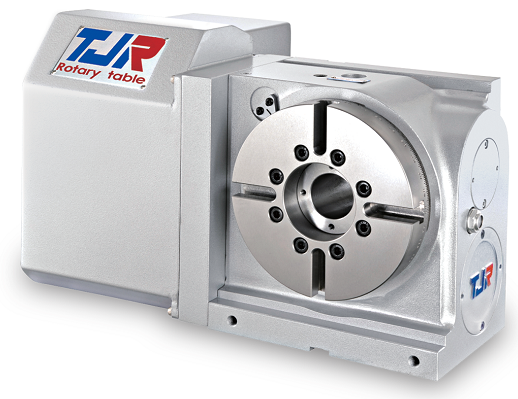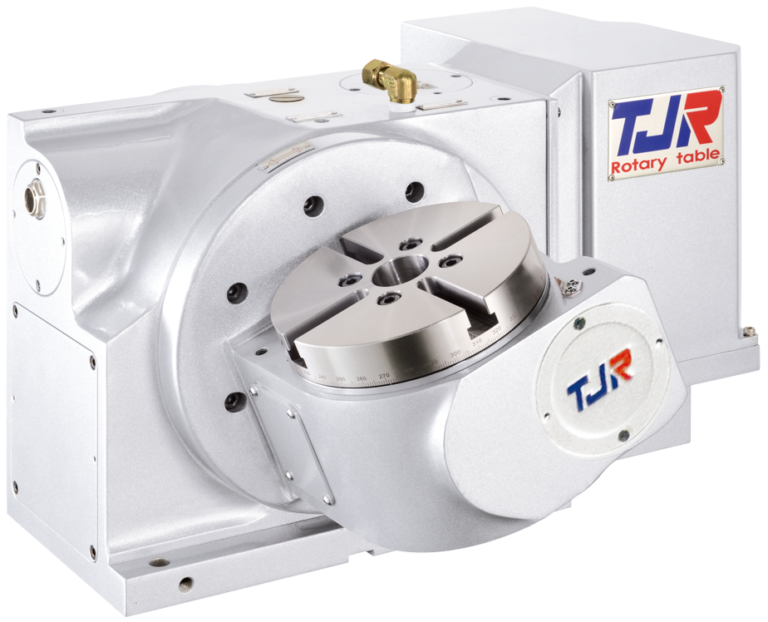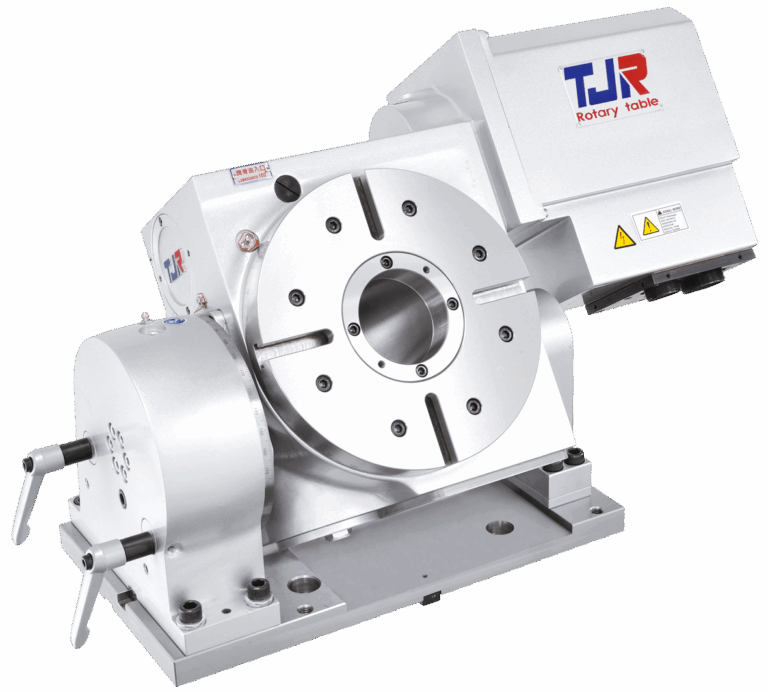
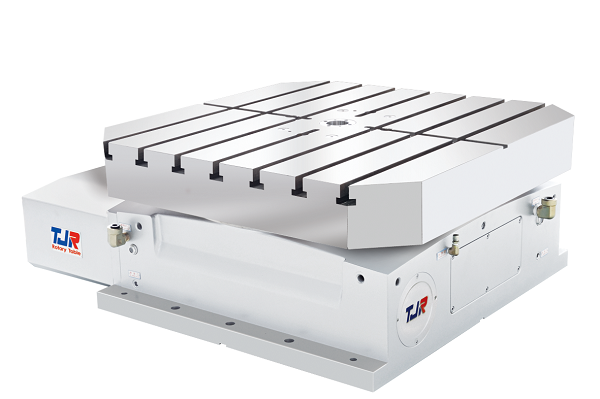
An indexing rotary table, also known as an indexing table, is a tool used to quickly and precisely rotate a workpiece so that a new edge is exposed for cutting. Among other things, indexing makes it possible to accurately manufacture large quantities of identical, interchangeable parts in a cost-effective manner.
Absolute Machine Tools’ TJR indexing tables are invaluable in milling and other industrial processes that require high precision cutting and shaping. They have a wide range of applications, including machining, positioning, inspection, and automation. Whether you’re running a small job shop or a large-scale manufacturing operation, this guide will walk you through everything you need to know to choose the right CNC indexing rotary table for your needs.
What Does a CNC Indexing Rotary Table Do?
In manufacturing, indexing is the process of exposing a new edge or surface for use. An indexing table is used to convey and position workpieces during a manufacturing process.
The table’s indexing unit rotates the piece a precise distance into a specific position. It remains in place while the manufacturing tool cuts or drills the workpiece. Once the operation is completed, the table indexes the next section of the workpiece into position.
An indexing rotary table is specifically designed to rotate an object indexed through preset angles, usually with some sort of detent system that holds the object at each angle for accurate positioning. This distinguishes it from a standard rotary table, which rotates continuously without preset stops.
Today, most indexing is performed using CNC technologies. CNC indexing rotary tables are designed with computer numerical controls, allowing the operator to run the machine with ease. With these controls in place, there is minimal human intervention in manufacturing operations — all the operator needs to do is input the command parameters into the machine and it will perform the programmed tasks.
Machining Applications: What Can You Do With One?
Index tables are used in a wide range of applications. Absolute Machine Tools offers high-end rotary index tables that are suitable for the most precise applications, including:
- Cut arcs, circles, and complex curves
- Bore holes and cut large diameter holes
- Make any-angle straight cuts
- Cut gear teeth
- Drill holes that are precisely spaced
- Rotate workpieces for additional operations without re-clamping
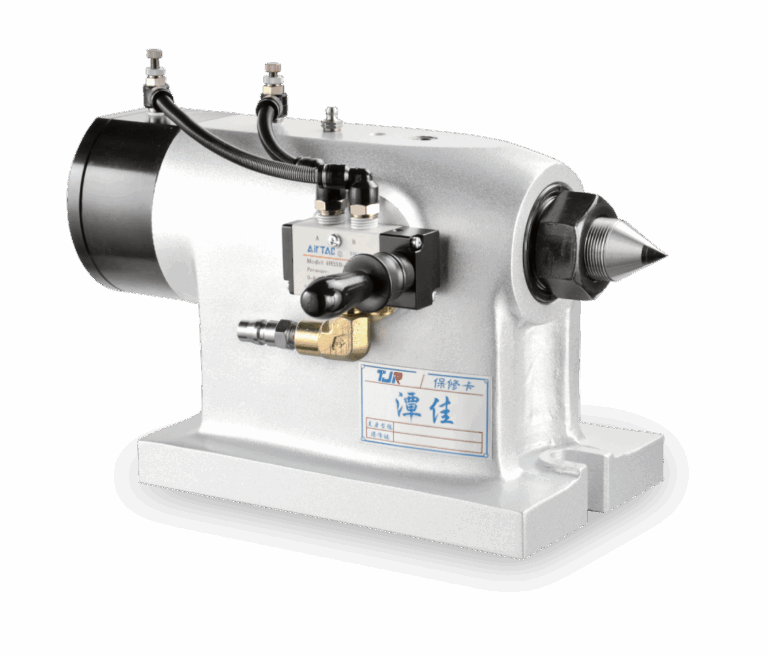
These tables can be rotated in controlled increments for precisely milled angles. When used with a dividing head and an index plate, the table operator can mount the table horizontally with a tailstock to make gears or drill holes in round stock.
Absolute Machine Tools’ CNC indexing tables are used in the machining process for parts and components across a wide range of industrial applications, including aerospace, defense, medical, automotive, food and beverage, printing, and construction.
Five Things to Consider When Choosing a CNC Indexing Rotary Table
When you decide to invest in an indexing rotary table, one of the biggest challenges will be finding the right table to best suit the needs of your manufacturing operations. There are many factors to consider when making your decision, including cost, features, accuracy, functions, and durability. Here are five things you need to consider:
1. Table Size and Specifications
Table specifications are one of the most important things to consider. Be sure to take into account the maximum size of the workpieces you’ll need it to accommodate when deciding on the diameter needed for your indexing rotary table. The CNC index tables offered by Absolute Machine Tools can be used for a wide range of applications and can be easily customized for the needs of your shop. We offer models with table sizes ranging from ranging from 320mm (12.59″) to 800mm (31.49″) in diameter, and they can be equipped with all the necessary accessories such as clamps, chucks, drill fixtures, and turning tools.
The HHI-Series features a square table top design and is engineered for horizontal mounting only, which offers high weight capacities for large workpieces. The tables do not lift the working table during indexing, ensuring positioning accuracy.
2. Power Source
Indexing tables have different power sources, each suited to different production environments:
- Electric: Electrically powered indexing tables are the most popular type and are available in many different versions. In many instances, electrically powered indexing tables are capable of faster indexing and can handle heavier loads than other types of tables.
- Pneumatic: Pneumatic indexing tables are driven by pneumatic cylinders and are well suited for high-cycle applications.
- Hydraulic: Hydraulic indexing tables are powered by pressurized hydraulic fluid and deliver the highest clamping force — ideal for heavy cutting applications. This is the standard brake on TJR’s HHI-Series indexing tables.
- Manual: Manual index tables, like the Ganro GCT Series, use a pneumatic or hydraulic connection for the clamp/unclamp operation and are indexed by hand rather than by a CNC control.
3. Gear Design: Wormgear vs. Facegear
Wormgear designs are the most popular indexing rotary table design on the market, providing a high level of flexibility with 1 degree or 5 degree indexing increment options. Facegear indexing tables are generally used in dedicated applications and provide the extreme rigidity required for heavy cutting applications.
It’s worth noting that not all wormgear systems are equal. TJR indexing tables feature a dual lead worm gear design — a one-piece wormshaft that eliminates backlash by allowing axial adjustment. This is more accurate than split-type worm gear systems, which use a two-piece design that can interrupt the line of contact and create friction. The dual lead worm and worm gear in TJR tables are made from high-tensile brass, with an estimated wear life of 10 years — more than twice the life of aluminum bronze components.
Learn more about the benefits of dual lead worm gear over split type.
4. Drive Configuration
An indexing rotary table can have different drive configurations, each suited to different production requirements:
- Cam index drives: The best choice when high-speed indexing is required.
- Roller gear index drives: Ideal in situations where medium to high torque and right-angle shaft orientation are needed.
- Ring index drives: Highly versatile, suitable for a wide range of applications.
5. Mounting Configuration
You have three options when it comes to mounting:
- Vertical: Vertically mounted tables come standard with 3 axes and are the most popular type.
- Horizontal: Horizontally mounted tables come standard with 5 axes. The TJR HHI Series is designed for horizontal mounting only, making it particularly well suited for horizontal boring mill applications.
- Versatile: Versatile mounting options allow you to tackle a wide range of projects and accommodate both orientations — a good choice for job shops running varied work.
Control Options
CNC indexing rotary tables have an assortment of control functions, making them an ideal tool for companies engaged in metalworking, fabrication, and manufacturing. To adjust the speed, pressure, and processing of CNC indexing rotary tables, here are the common key control options:
- Division Mode: This option allows operators to run the machine according to their preferred number of equal rotations or divisions — ideal for bolt hole patterns, gear teeth, and other equally spaced features.
- Degrees Mode: This selection provides operators with the option to adjust the rotational degrees of the machine to any specific angle.
- Program Mode: This mode permits operators to program the way the machine carries out its application — fully programmable sequencing for complex multi-step operations.
CNC indexing rotary tables are also equipped with a separate switch to disengage components and stop all operations immediately.
For shops that need the flexibility to use an indexing table across multiple machines rather than integrating into a single machine control, TJR’s DAC (Dual Axis Controller) provides a standalone control option.
Maintaining Your Indexing Rotary Table
Because an indexer is a precision machine, it requires regular maintenance. The following guidelines should be followed for proper care of your indexing table:
- Perform regular cleaning of your table to ensure that dust does not get into the machine.
- Remove chips or debris from the machine with a compressed air gun or vacuum cleaner.
- Perform routine inspections at the beginning of every job to ensure that the rotary index table is in perfect working condition.
- Check all machine components to determine if they are worn.
- If possible, use a dial indicator to measure the rotary table’s bearings for any inconsistencies or wobbling, which can result in inaccurate indexing or sticking of the table.
- Replace any worn or damaged machine parts immediately.
Why TJR Indexing Tables from Absolute Machine Tools
It doesn’t matter if you’re a small manufacturer or a large one, Absolute Machine Tools can help you find the right indexing rotary table for your needs.
Absolute Machine Tools has been a premier importer and distributor of quality machine tool accessories since 2007. Our line of TJR Precision Technology rotary and indexing tables turns any 3-axis machining center into a 4- or 5-axis with customized faceplates available. TJR tables feature:
- Anti-wearing dual lead worm gear with an estimated 10-year wear life
- High-tensile brass shafts and worm gear components
- Bronze roller bearings to reinforce vital components
- Protection of key parts against dirt, grime, and dust for longer machine life
- Table sizes from 18 to 96 inches in diameter
- A 3-year parts warranty on all new tables
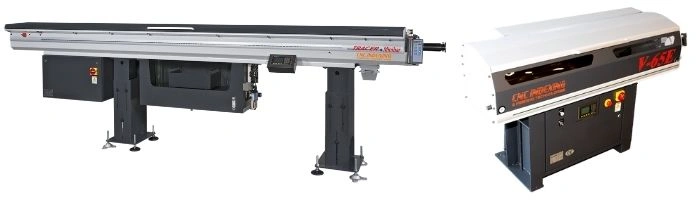
In addition, Absolute Machine Tools’ offers hydrodynamic magazine bar feeders, short bar loaders, and high pressure coolant systems.
Contact Absolute Machine Tools today at 800.852.7825 to learn more about how our high-quality indexing tables can increase your production capabilities, improve accuracy, and reduce manufacturing cycle times.